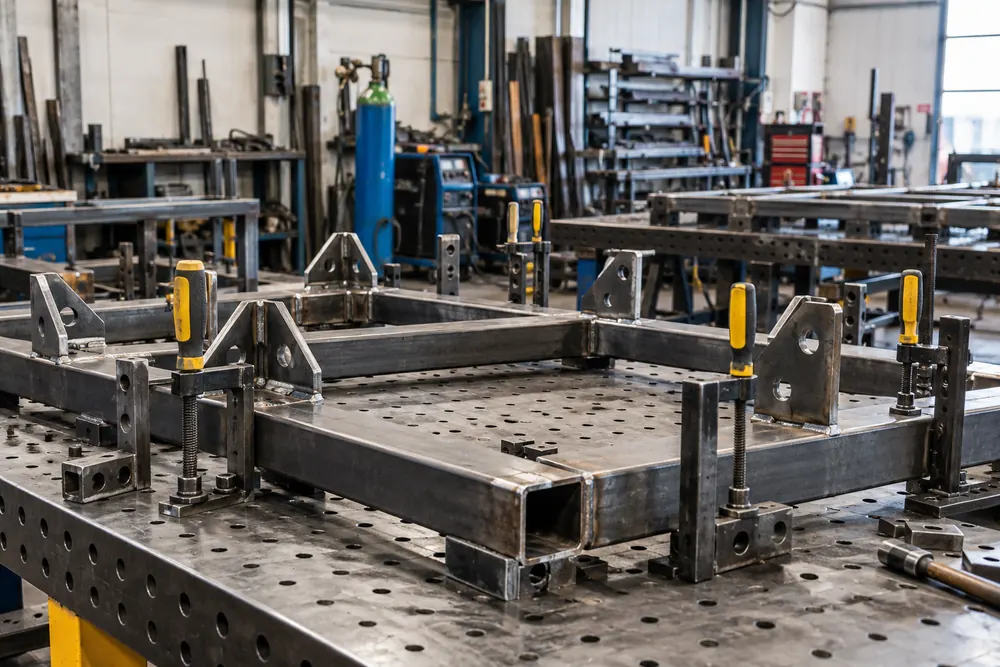
Turn A Requirement Into A Fabrication Package
Metal fabrication covers the cutting, drilling, forming and joining needed to make a functional assembly. For commercial sites, that might mean a support frame, mounting bracket, equipment stand or replacement metal component. The starting point is the job the assembly needs to do and the conditions in which it will operate.
We welcome enquiries from contractors, facilities managers and procurement teams who need to turn that requirement into a defined fabrication scope. Include the purpose, installation location and any existing drawings. If you only have photographs, describe the missing information rather than supplying estimated dimensions as final measurements.
Define Loads And Connections Early
A frame that looks substantial can still be unsuitable if its connections, base or supporting floor have not been assessed. Identify static loads, vibration, impact, movement and any maintenance activity that could change how the assembly is used. An engineer may need to specify member sizes and fixings where performance is safety critical.
Interfaces deserve the same attention as the main body of the fabrication. Hole centres, mounting faces, clearances and access for a spanner can determine whether installation is straightforward. Where another contractor supplies equipment, request their approved interface drawing before manufacturing the support.
Materials And Finishes For Commercial Use
Mild steel is often chosen for fabricated frames and brackets, with corrosion protection matched to the environment. For Hull factory components, stainless steel or aluminium may be appropriate where washdown, corrosion exposure or weight limits influence the material choice. Their grades, joining methods and finishes need to be specified rather than treated as direct substitutes.
Finishes should be described by the required preparation and coating system, not just a colour. Exterior assemblies, damp plant areas and frequently cleaned spaces have different demands. Drainage, crevices and access for future maintenance also influence how long a fabrication remains serviceable.
Standards Follow The Function
There is no single approval that makes every metal fabrication suitable for every purpose. Load-bearing construction components within scope need the relevant BS EN 1090 assessment and execution requirements. A bracket for an enclosure may have a different route, depending on its role and the system it forms part of.
For equipment-related work, the Provision and Use of Work Equipment Regulations 1998 are relevant to safe provision and use. Altering a guard or support must be assessed against the equipment risks. Welding fume controls also matter during manufacture and site work, as explained in HSE’s COSHH guidance for welding.
The Fabrication Process
First, establish the intended use and collect drawings, measurements and site photographs. Confirm the design owner and whether a site visit or survey is needed. The scope should name the materials, finish, quantities and installation responsibilities so the quote can be assessed against the actual requirement.
Second, agree manufacturing details and approval points. Cutting, drilling, fitting and welding follow a controlled sequence that accounts for access and distortion. Trial assembly can be useful where several pieces connect together or where site installation leaves little room for adjustment.
Third, inspect the agreed dimensions and workmanship before finishing and dispatch. Confirm what records are required and how the components will be identified. If the work includes installation, coordinate isolation, permits, access equipment and working areas with the people responsible for the premises.
Quoting And Avoiding Rework
Cost depends on material, the complexity of the assembly and the time needed to make it accurately. Numerous small welded details, difficult access, close tolerances and specialist finishing can add labour without adding much weight. Batch size and whether jigs are needed also influence the production approach.
Give the required delivery date as well as the ideal date, and say whether the work is linked to a shutdown or another trade. Mark changes clearly when revising an enquiry. For thin folded parts, use sheet metal fabrication, while one-off geometry is covered under bespoke steelwork.
Metal Fabrication FAQs
Can Metal Fabrication Be Supplied Without Installation?
Metal fabrication can be scoped as supply only, with installation arranged separately, when that is agreed in the quote. Confirm who measures the site, checks the supports and provides fixings. The receiving team also needs delivery dimensions, component weights where relevant and a safe method for unloading and positioning the assembly.
Can A Metal Component Be Copied?
A metal component can sometimes be reproduced from a sample, but copying its shape does not establish that it is safe for the intended duty. Explain why replacement is needed and identify any failure or wear. Material identification, design review and dimensional checks may be necessary before manufacture is agreed.